DIVERSA
Forest disturbances under climate change in Lower Saxony: Understanding drivers and impacts to enhance forest adaptability

DIVERSA aims to understand and increase the natural resilience of forests to climate change-related disturbances.
During past droughts, the vulnerability of Lower Saxony's forests to the increasing effects of climate change became evident. So far, the understanding of the natural potential of forests to adapt to climate change-induced disturbances is limited. An in-depth study of the causes and effects of disturbances is important in order to develop effective strategies to improve the adaptive capacity of forests in a timely manner.
The perspectives of forest owners, forest managers, forest policy makers, other important stakeholders and the public must be included in decision-making processes. Forest monitoring systems must be improved and expanded as adaptive management tools in order to enable evidence-based decisions and continue to ensure the sustainable functionality of our forests.
This is where the Klima.Zukunftslabor ‘DIVERSA - Forest disturbancesunder climate change in Lower Saxony: Understandingdrivers and impacts to enhance forest adaptability’ is establishing a trans- and interdisciplinary research unit to improve the adaptability of forests to climate change in Lower Saxony. The research objectives of the Climate Future Lab are, on the one hand, to increase the understanding of the resilience of Lower Saxony's forests to climate change-related disturbances. To this end, robust statistical data is provided on the probability of disturbance depending on important disturbance agents (storm, drought, pests, fire), the geophysical site conditions, the management history and the structural and tree species diversity of the forests. Remote sensing data (satellite and aerial images, airborne laser scanning), existing monitoring systems and geodata, as well as forest inventory and forest condition data are combined for modelling.
On the other hand, DIVERSA assesses the resistance and resilience of ecosystem services and the response of biodiversity to disturbances. The lab records the extent of structural and compositional changes in forests and forest functions. The response of biodiversity is determined by a comprehensive survey of species and structural diversity in forests in the state forests of Lower Saxony that have been taken out of use and managed and supplemented by data from nature conservation authorities and participatory citizen science platforms.
The third research objective is to understand the views of different forest owners, other stakeholders and the public on forest disturbances and to include them in participatory and effective decision-making for desired forest conditions. On the basis of DIVERSA, existing instruments for monitoring, decision support and management of Lower Saxony's forests can be further developed. DIVERSA aims to catalyse the establishment of a permanent research network for the adaptation of forests to climate change and to create better future prospects for forests and society.
Spokesperson


Subprojects
DIVERSA SP1 - Future lab coordination and carbon storage
ExploreDIVERSA SP2 - Monitoring climate-induced forest change
ExploreDIVERSA SP3 - Functional drought resistance of trees
ExploreDIVERSA SP4 - Dynamics of insect diversity
ExploreDIVERSA SP5 - Soundscapes
ExploreDIVERSA SP6 - Future forest development and climate-induced disturbance probability
ExploreDIVERSA SP7 - Integration of stakeholders’ perspectives on changing forests
ExploreDIVERSA SP8 - Public awareness: Environmental perceptions, knowledge & public relations
Explore
Project partners
- Nordwestdeutsche Forstliche Versuchsanstalt
- Georg-August-Universität Göttingen
- Leuphana University Lüneburg
- Alfred Toepfer Akademie für Naturschutz
- Hessian Agency for Nature Conservation, Environment and Geology
- University Marburg
- Technische Universität München
- Utrecht University
Practice partners
Blog
All
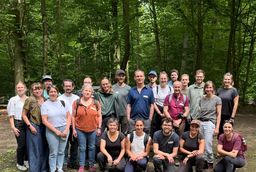
Coordinating Group meets in Göttingen
DIVERSA invites the network to a field trip to the forest
4 min. Reading time
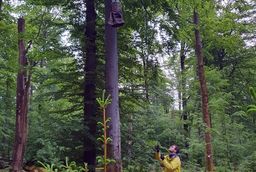
How is climate change affecting our forests?
Interactive stations showcase research in practice
6 min. Reading time
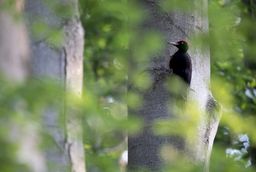
Is the black woodpecker endangered in Lower Saxony due to the loss of coniferous wood caused by calamities?
A guest contribution by Dr. Marcus Schmidt and David Singer from the Northwest German Forest Research Institute
3 min. Reading time