Tree Climbing vs. Drones – A Research Showdown in the Canopy
- April 13, 2026
- 4 min. Reading time

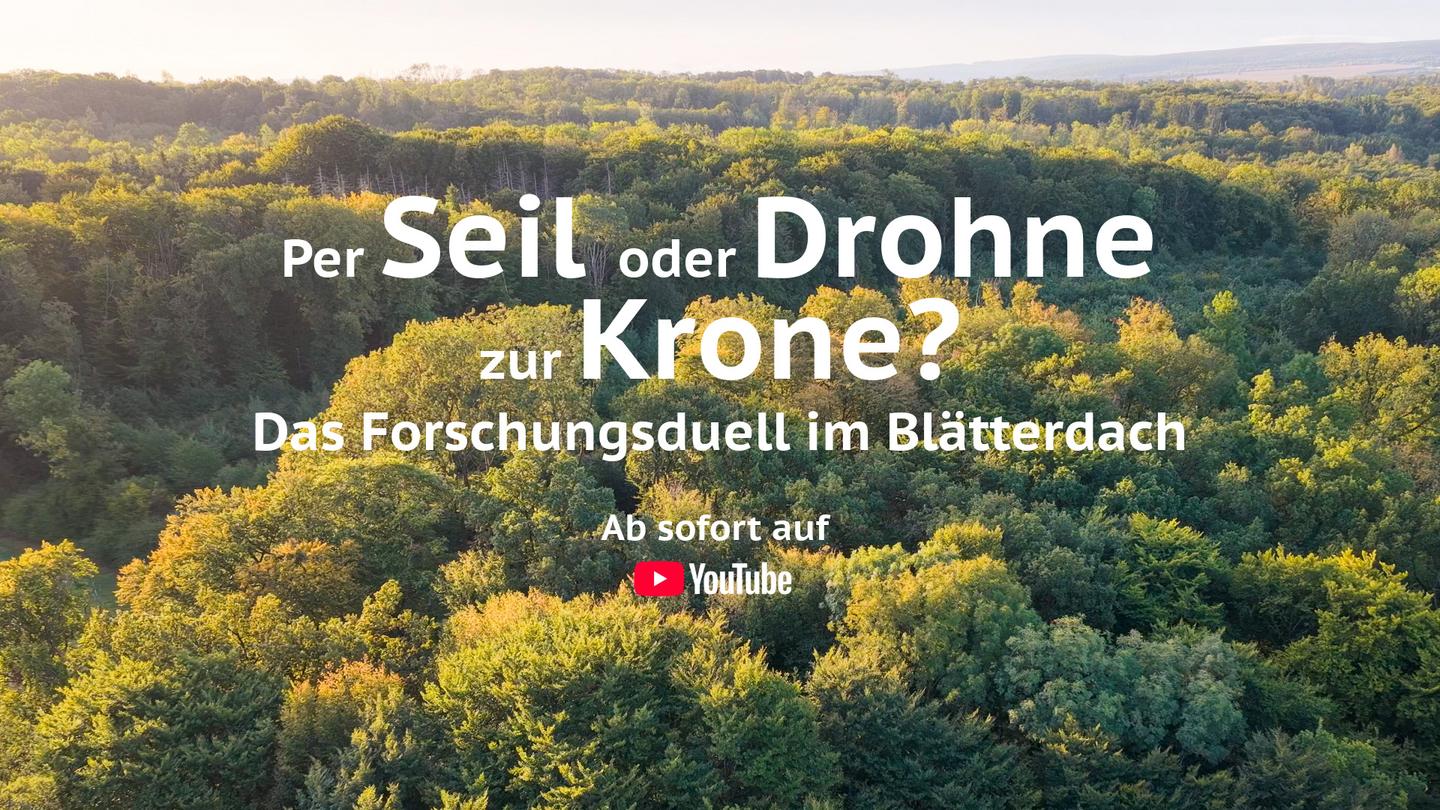
High up between the treetops and the sky, an extraordinary showdown is taking place: two research teams from the FoResLab Climate and Future Laboratory are going head-to-head. “Team Climbing” and “Team Drone”—two approaches with the same goal: to collect valuable samples from the tree canopy to better understand the health of the trees and thereby lay the groundwork for resilient and sustainable forest management. In a direct comparison, the teams aim to determine which method—tree climbing or drones—is faster, safer, and more efficient. The result is a film that brings research to life in an accessible and lighthearted way.
Science communication that's fun!
The film, which is now available on YouTube, follows the two teams as they take on their challenge in a forested area southwest of Hanover. There, at a height of more than 30 meters, they collect small branches and leaf samples—demonstrating what forest research in the context of climate change can look like in practice.
Accompanied by Sharath Shyamappa Paligi from the University of Göttingen, Dr. Christina Hackmann climbs into the treetops herself with courage and physical strength. Malkin Gerchow and Steffen Dohmen from the Technical University of Braunschweig, on the other hand, rely on a specially developed sampling drone. The challenge is accompanied by Dr. Matthias Beyer, also from the Technical University of Braunschweig. Over nine rounds, viewers will not only learn about the methods but also get to know the people behind them: their motivation, their approach, and the challenges that come with conducting research under real-world conditions—and why this work is crucial for better understanding forests in the context of climate change.
Why collect samples from the tree canopy?
Our forests are under pressure. Heat, drought, and extreme weather are taking their toll. And the effects are often first visible where they’re barely noticeable from the ground: in the tree canopies. Climate change is taking an increasingly heavy toll on forests and poses major challenges for science and forestry. What should the forest of the future look like? What structures and species compositions ensure that the forest is particularly resilient to changing environmental conditions? The samples provide the foundation, because researchers can glean crucial information about a tree’s condition from its leaves and branches. They offer insights into water and nutrient balance, stress responses, and adaptability. This is precisely the data researchers need to better understand how forests respond to climate change and how they can be made more resilient in the future.
A Comparison of Two Methods
The comparison quickly reveals that there is no single perfect method. The drone can reach even hard-to-access trees and is particularly effective over large areas—that is, when sampling multiple trees—allowing it to collect many samples. However, it is difficult to control it with precision. Climbing, on the other hand, is possible even in wind and rain, when the drone can no longer fly. That said, it also requires training, experience, and a certain amount of respect for heights. But it also allows for immediate proximity to the research subject, or as Christina Hackmann describes it: the moment when you simply sit quietly up in the canopy, listen to the rustling of the leaves, and enjoy the view. An advantage that no drone can provide.
Cooperation Instead of Competition: Collaborative Research
However, the fact that the teams “compete” with one another at all is an exception. In their day-to-day work, they collaborate closely—at the FoResLab Climate and Future Laboratory, a consortium that brings together precisely these diverse perspectives in an interdisciplinary and transdisciplinary manner. There, data is collected at fixed locations over several years—by different disciplines, using different methods, but always focusing on the same trees. This creates a comprehensive picture that individual approaches alone could not provide. That is precisely the crux of the matter: not competition, but complementarity.
How does the duel at lofty heights turn out? We won’t reveal that here. The film is now available on YouTube: https://www.youtube.com/watch?v=CSGO046Ahqo
Background on the film
The film is based on an idea by Dr. Matthias Beyer (isotope ecohydrologist, Technical University of Braunschweig) and Dr. Christina Hackmann (forest ecologist, University of Göttingen)
Additional contributors: Malkin Gerchow (eco-hydrological engineer, Technical University of Braunschweig), Steffen Dohmen (geoecologist, Technical University of Braunschweig), and Sharath Shyamappa Paligi (plant ecophysiologist, University of Göttingen).
A collaboration between:
TU Braunschweig
Universität Göttingen
Kreativstudio für Wissenschaftskommunikation Zum Staunen*
Funded by:
Deutsche Forschungsgemeinschaft (DFG)
Eva Mayr-Stihl Stiftung über den Innovationspool des Kompetenzzentrums Landschaftsresilienz der Universität Göttingen
More Posts
All
Climate Research Through Dialogue: “Climate Future Lower Saxony” Symposium 2026
First results are becoming visible – and with them, the question of how they can unfold their impact together with practice.
2 min. Reading time
Climate-Resilient Agricultural Landscapes in Lower Saxony
The sixth Climate Future Lab, AgRe-Lab, combines biodiversity and climate research with regional practice
2 min. Reading time

OpenPlanning Zine 03 "Somethings Cooking"
The zine shows how cooking together and co-creative urban design are sparking new ideas for a mobile climate garden in Braunschweig.
2 min. Reading time