Is the black woodpecker endangered in Lower Saxony due to the loss of coniferous wood caused by calamities?
- March 3, 2026
- 3 min. Reading time

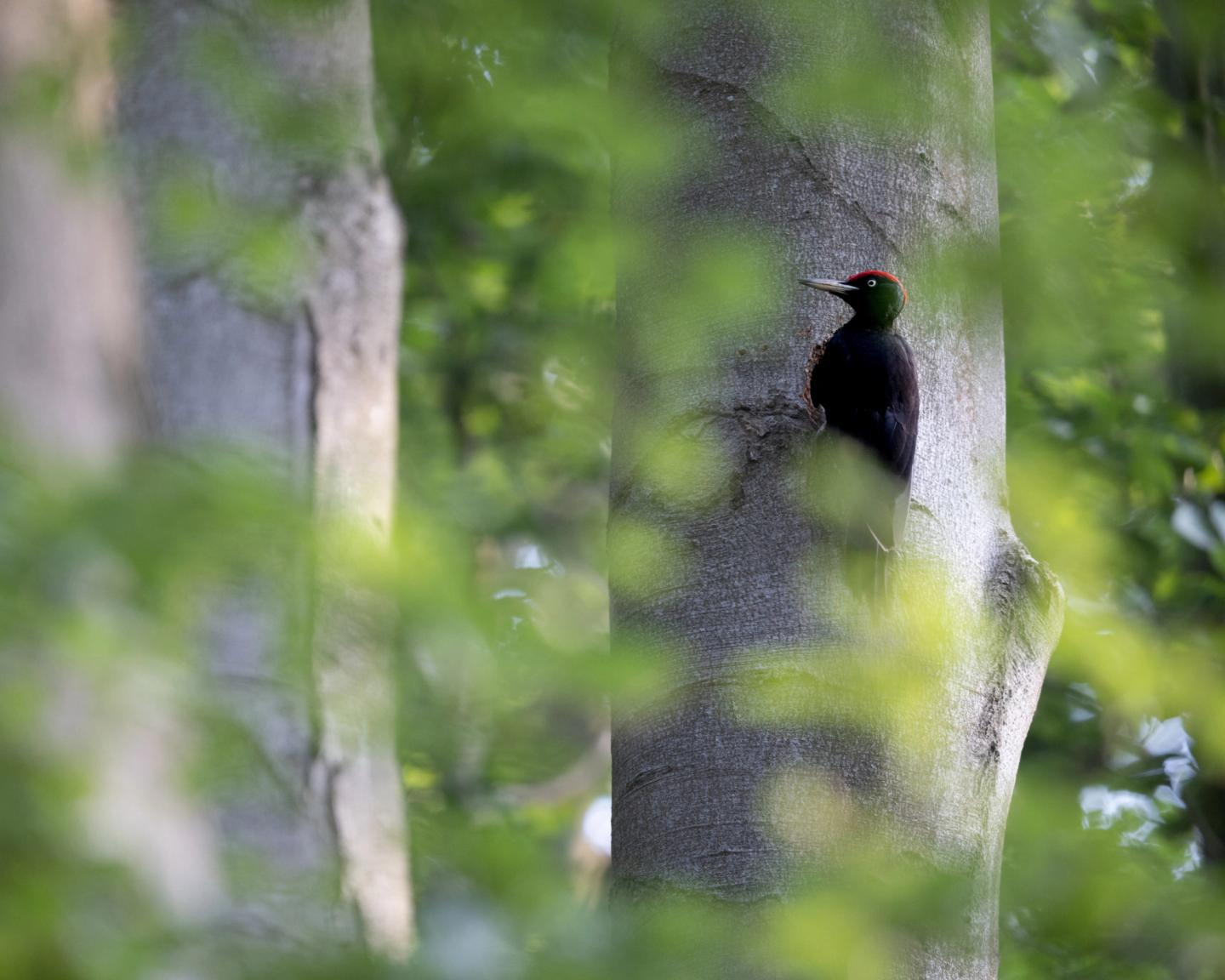
On the occasion of the International Day for Biological Diversity, we take up the question of how changing forest structures as a result of climate change and forest dieback affect forest-dwelling species. One example from Lower Saxony is the black woodpecker.
Until the end of the 19th century, the black woodpecker (Dryocopus martius) was extremely rare in the mountainous regions of Lower Saxony and was even completely absent from the lowlands. One possible reason for its increased spread from around 1890 onwards, which has often been discussed in the specialist literature, is the increased cultivation of coniferous trees that took place in the 19th century. To this day, many ornithologists assume that the black woodpecker is dependent on coniferous trees, especially spruce. If this were the case, the species could be regionally threatened by the massive die-offs that have been observed in spruce since 2018.
Historical causes of the decline
As early as 2016, a literature study by the Northwest German Forest Research Institute (NW-FVA) showed that it was not the lack of coniferous wood that was decisive for the earlier disappearance of the black woodpecker in the Northwest German lowlands. Rather, the following factors were more decisive:
- low forest cover
- small tree dimensions and low wood stocks
- lack of canopy closure in prevailing coppice forests
- severe fragmentation of suitable habitats
- active persecution of the species
It was the combination of these factors that led to regional extinction - not a lack of conifers.
Not a coniferous forest specialist, but a habitat generalist
The results of numerous recent studies also show that the black woodpecker should not be classified as a coniferous forest species, but rather as a habitat generalist. The main importance of coniferous wood for it lies in the provision of decayed stumps, which are colonized by ants and other invertebrates and thus improve the food supply. However, coniferous wood is not important for the occurrence and settlement density of the black woodpecker if there is sufficient dead wood in deciduous forests.
If these conditions are met in a forest, the black woodpecker can be easily observed in early spring, when it begins courting and building its nest. It is easily recognizable by its loud mating calls, which it makes while sitting or flying, and its characteristic drumming.
Acoustic monitoring in the DIVERSA project
This loud “courtship spectacle” is recorded throughout the year in the DIVERSA project using small audio recording devices and evaluated using AI. This will enable the habitat preferences of the black woodpecker (and other bird species) to be characterized even more accurately in the future under the changing conditions in Lower Saxony's forests. In the wake of climate change, it is also possible that the black woodpecker will begin its courtship earlier in the year. The acoustic recordings made in the DIVERSA project throughout all seasons can provide information about possible seasonal shifts in the courtship activity of the black woodpecker.
Conclusion: The findings to date indicate that the black woodpecker is less dependent on certain tree species than is often assumed. Rather, structurally rich, sufficiently large forest areas with a good supply of deadwood are crucial.
Both guest authors work in Subproject 5 “Bioacoustics” of the Climate.Future Lab DIVERSA, which investigates the impact of drought stress–induced disturbances on the composition of bird and bat communities in forests.
Dr. Marcus Schmidt heads the Species and Biotope Protection Unit within the Forest Nature Conservation Department at the Northwest German Forest Research Institute.
David Singer is a research assistant at the Northwest German Forest Research Institute, Forest Nature Conservation Department, Species and Biotope Protection Unit, and is pursuing his doctorate at the University of Göttingen.
More Posts
All
Coordination Meeting of the Climate Future Labs in Braunschweig
The exchange focuses on the interfaces between the laboratories
3 min. Reading time

Taking a holistic approach to climate adaptation in cities
Interview with UMEX-HOPE speaker Prof. Dr. Björn Maronga
7 min. Reading time
Big visions, but quick small steps
Social sustainability arises when different actors take responsibility, act together, and combine big visions with concrete, small steps.
4 min. Reading time