
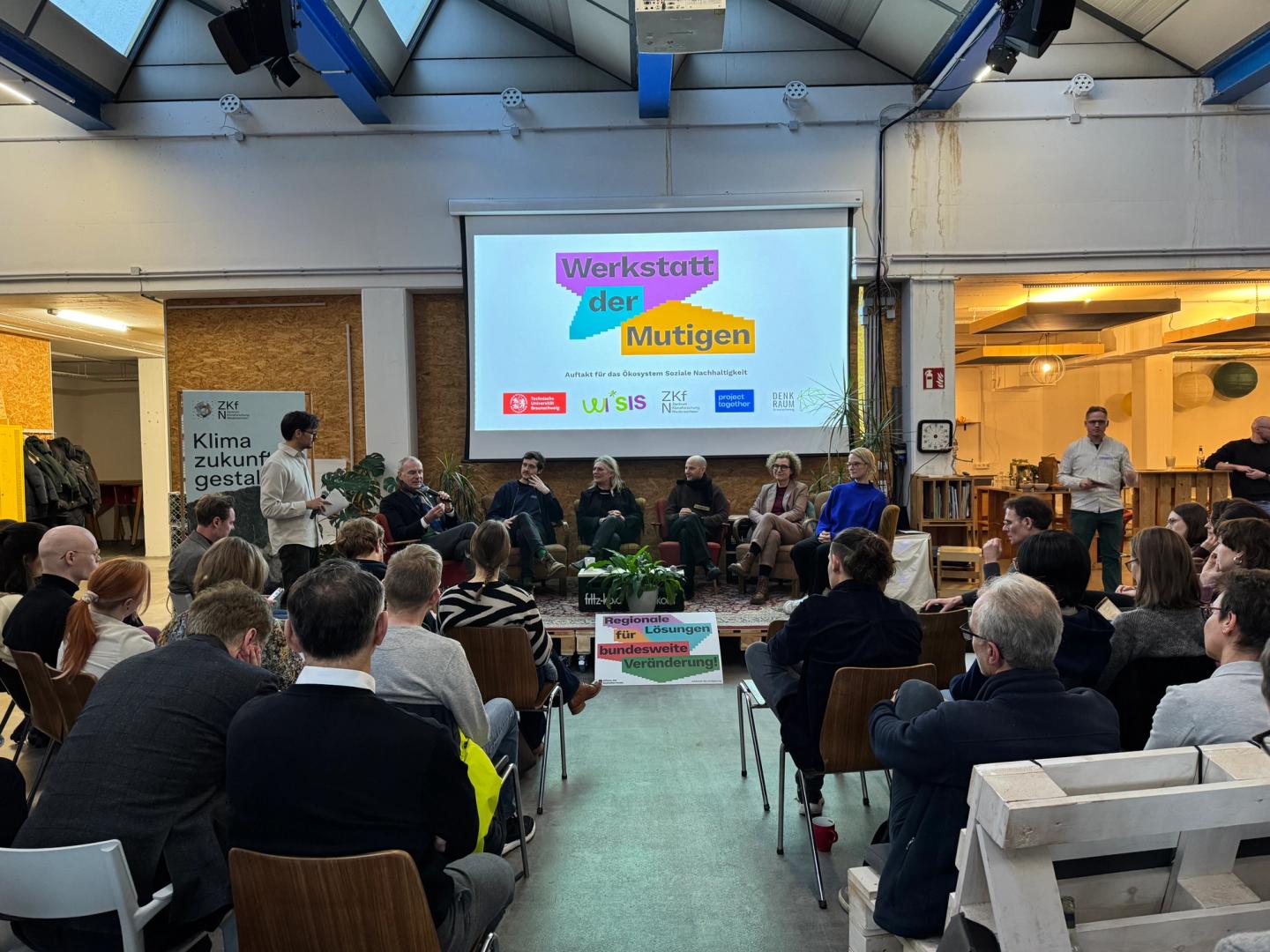
How does social sustainability actually come about locally? And what is needed to turn good intentions into sustainable structures?
At the “Werkstatt der Mutigen” (Workshop of the Courageous) at DenkRaum Braunschweig on February 20, more than 80 stakeholders from business, science, politics, culture, education, and civil society came together to discuss precisely these questions and to further develop the “Ecosystem Social Sustainability” (ESS) network. The ZKfN supported this event as a cooperation partner and contributed its expertise in the field of sustainable transformation processes in the region. Other partners include ProjectTogether and Enactus Braunschweig e. V.
Translating and living social sustainability
The ESS network was initiated by Prof. Dr. Susanne Robra-Bissantz from the Institute for Information Systems at the Technical University of Braunschweig as part of the “Ecoversity” initiative. In her welcome address, she made it clear that social sustainability is an abstract construct that we need to translate and live by. She emphasized: “We are all united in one thing: we are interested in people's well-being, curious, and open-minded.”
Since fall 2025, several working groups in Braunschweig have been collaborating on topics such as “social participation,” “transformative education,” “rural areas,” and “open free research.” The long-term goal is to solve problems together and develop concepts that are also financially viable.
It became clear that this requires spaces where people can feel a sense of community and experience energy live. Equally important is tolerance for ambiguity—the ability to endure uncertainty and ambiguity. Especially in times of global crisis, it is important to be a region where no one is left behind. For research, according to Robra-Bissantz, this means that if research shapes society, it must ask itself where it is researching—towards what benefits society.
Public welfare before profit maximization
In a panel discussion, representatives from business, culture, education, and the nationwide organizing team of the “Werkstatt der Mutigen” (Workshop of the Courageous) reported on how they implement social sustainability in practice.
They agreed that the common good takes precedence over profit maximization. And that commitment does not come from brochures, but from concrete action.
Some practical examples:
- Dr. Alexander Tourneau, member of the board of Öffentliche Versicherung Braunschweig, reported that the company provides affordable rental space in the city for social initiatives and allows its employees to take one day off per year to do volunteer work.
- Dr. Heike Pöppelmann, director of the Braunschweig State Museum, spoke about opportunities for participation, whereby citizens can contribute objects from their family collections or help develop exhibition ideas.
- Joanna Haag from SEEd – Social Entrepreneurship Education in Kiel showed how social innovation can be implemented in schools. In free project weeks, students develop their own solutions to ecological and social challenges. The focus is on economic education – from the idea to implementation. This creates concrete self-efficacy.
Just do it
A central theme of the evening was that big visions are important. At the same time, quick, small steps are needed to build momentum. Or, as it was put several times:
Just do it.
Go out and bring people in.
And ask people if they want to join in.
The appeal was to build the network, or on a larger scale, the ecosystem, at an early stage—before social tensions and financial bottlenecks further restrict the scope for action. To achieve this, it is important not to lecture, but to engage in dialogue. After all, whether democracy works is something you experience locally, in cities and communities.
After the discussion, the work continued: in an interactive round of introductions, during the subsequent exchange at the buffet, and in conversations with the working groups, new contacts were made, concrete project ideas emerged, and a palpable spirit of optimism arose.
It goes on!
The workshop has shown that Braunschweig not only has ideas, but also the will to take responsibility and work together to take action. Vibrant networks emerge where different perspectives come together and where courage, openness, and perseverance meet.
The key now will be to translate this energy into lasting structures. The DenkRaum can become a central infrastructure for this—a place where cooperation is not only discussed, but also lived out on a permanent basis.
The next Werkstatt der Mutigen will take place on September 3 in Braunschweig. Anyone who would like to get involved can already make a note of the date, join one of the working groups, and actively contribute to the further development of the social sustainability ecosystem.
About the format „Werkstatt der Mutigen“
The Werkstatt der Mutigen is a nationwide event format organized by the Alliance of Designers and ProjectTogether. The central kick-off event took place on January 29, 2025, in Berlin. Since then, both partners have been continuously developing the format and bringing it to the regions in order to network local initiatives and strengthen social creativity. Edouard Morello, Project Manager of the Alliance of Designers, was also represented on the panel in Braunschweig.
Further information: www.werkstatt-der-mutigen.org
More Posts
All
Forest disturbances and climate shape the diversity of butterflies and moths
First scientific DIVERSA publication
2 min. Reading time
UMEX-HOPE launches with a newsletter and a LinkedIn page
Insights into research, processes and collaboration
1 min. Reading time
Coordination Meeting of the Climate Future Labs in Braunschweig
The exchange focuses on the interfaces between the laboratories
3 min. Reading time