
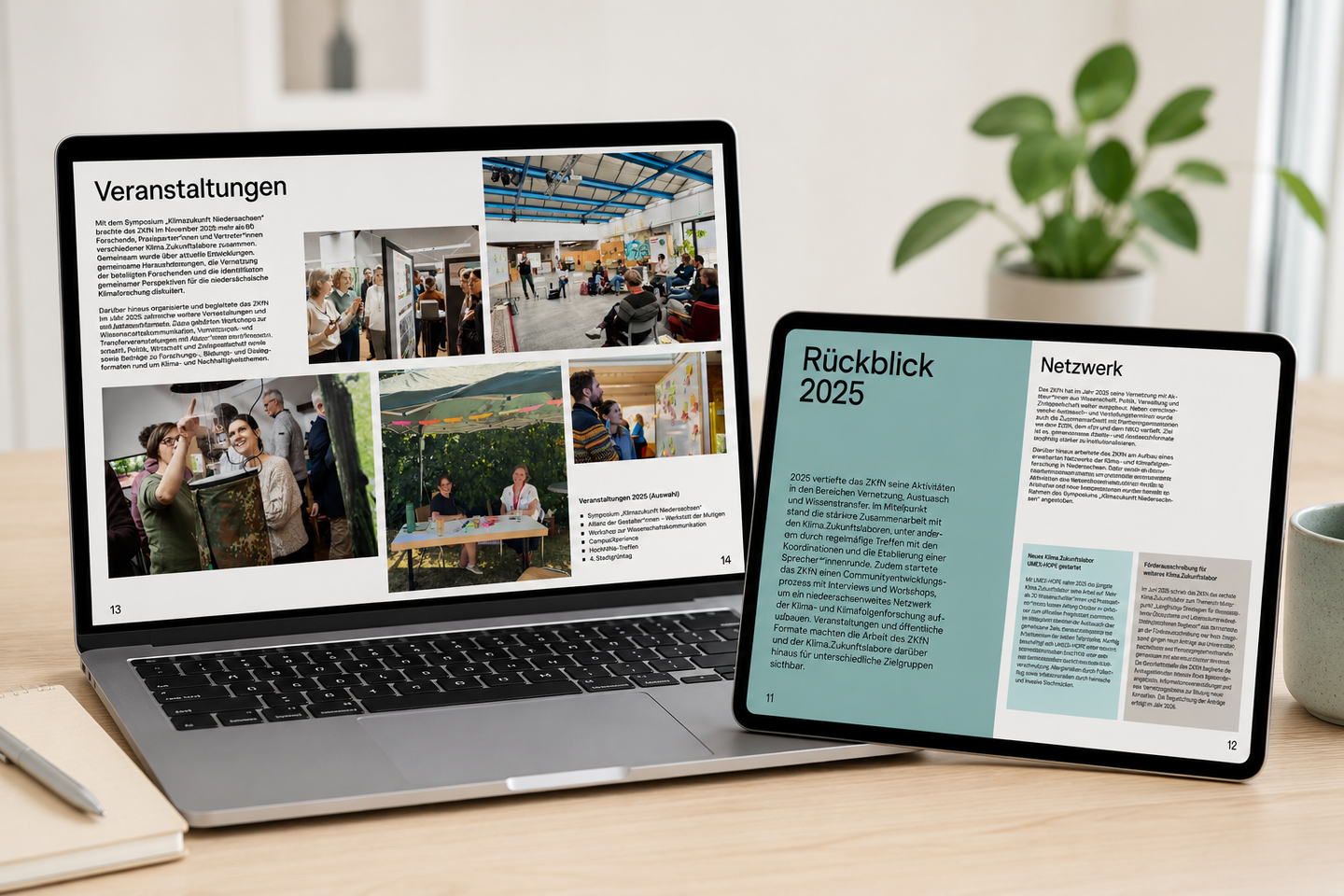
What topics shaped the Lower Saxony Climate Research Center (ZKfN) and its Climate.Future Labs over the past year? Answers to these questions can be found in the recently published 2025 Annual Report.
The report documents the most important developments, projects, and activities of the ZKfN and the five Climate Future Labs. It focuses on progress in interdisciplinary and transdisciplinary climate research, as well as on collaboration with partners from local governments, the business sector, and civil society.
In addition to a review of the secretariat’s work, the annual report offers insights into the research activities of the Climate Future Labs—ranging from climate-resilient forests and urban climate adaptation to sustainable urban development and strategies for the transformation of urban spaces. The report is supplemented by selected highlights of science communication, networking, and knowledge transfer.
The annual report is intended for anyone interested in the fields of science, politics, public administration, business, and society, and highlights how the ZKfN strengthens exchange between research and practice and fosters stronger connections across climate and climate impact research in Lower Saxony.
The 2025 annual report is now available for download as a PDF.
→ Download the 2025 Annual Report
More Posts
All
Climate Research Through Dialogue: “Climate Future Lower Saxony” Symposium 2026
First results are becoming visible – and with them, the question of how they can unfold their impact together with practice.
2 min. Reading time
Climate-Resilient Agricultural Landscapes in Lower Saxony
The sixth Climate Future Lab, AgRe-Lab, combines biodiversity and climate research with regional practice
2 min. Reading time

OpenPlanning Zine 03 "Somethings Cooking"
The zine shows how cooking together and co-creative urban design are sparking new ideas for a mobile climate garden in Braunschweig.
2 min. Reading time